This guide is free and there is nothing to fill in to read it. If you would rather not talk to anyone yet, that is a completely reasonable place to be — read this instead, and come back if and when you want a second opinion.
It is general information about the Alberta process, not legal or financial advice, and nothing here guarantees any outcome.
The short version of the process
Foreclosure in Alberta is a court-supervised judicial sale through the Court of King's Bench. A lender cannot simply sell your home — it has to go through the court, and the court sets the terms. In rough order: missed payments and lender contact, a demand letter, a Statement of Claim that starts the court case, an Order Nisi in which the court sets your redemption period, then a listing for sale, and finally an order confirming the sale and vesting title.
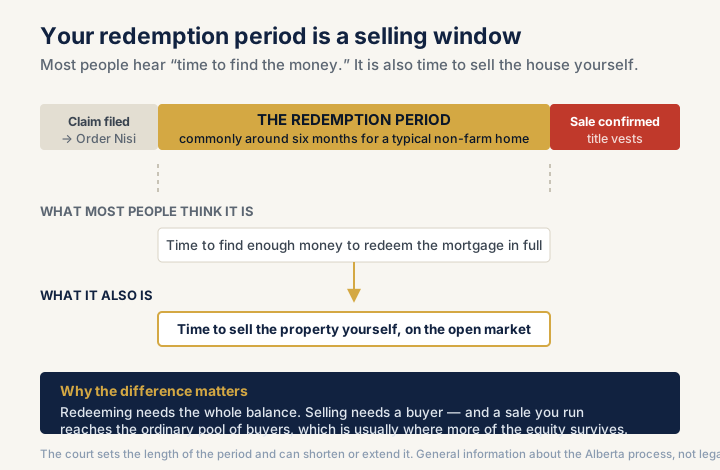
The redemption period is commonly around six months for a typical non-farm Alberta home, and the court can shorten or lengthen it depending on your ability to pay and the equity in the property. The full stage-by-stage timeline is here, and the process explained in detail is here.
Two things are worth taking from that. The first is that this is slower than most people fear — often somewhere between eight and fifteen months from the first missed payment to a confirmed sale, though it varies with the court schedule and the facts of the file. The second is that the redemption period is a window in which you can still act, and it is the single most valuable thing you have.
Where are you right now?
Find the line that matches your situation. Each one is a genuinely different position with different moves available, which is why "it depends" is the honest answer to most foreclosure questions.
I have missed a payment or two, and no lawyer has been in touch
You almost certainly have the most time and the most options of anyone reading this page. Talk to your lender about an arrears arrangement — yes, really — and start comparing your options while all of them are still open. What to do first if you are behind →
I have had a demand letter
That is a formal warning that legal action may follow, not the end of anything. It is still a good time to catch up the arrears, negotiate, refinance, or list the home before a court claim is filed.
I have been served a Statement of Claim
A court case has formally started, and there is a window in which to respond. This does not end your options — you can still respond, negotiate, or move toward a sale. This is the point at which independent legal advice is worth having.
An Order Nisi has been granted and I am in my redemption period
This is your biggest remaining window, and it is a selling window as much as a redemption one. You can generally redeem the mortgage, sell privately, or refinance right up until the court confirms a sale. Selling during the redemption period →
A sale has been scheduled or the lender has listed the home
Time is genuinely short now. If you want to explore redeeming or selling before the court confirms the sale, get legal advice immediately rather than after the next step.
I am not behind yet — I am planning ahead
That is a good instinct and an uncommon one. Understanding this before you need it is exactly how homeowners keep the most options and the most equity if things do get difficult.
Your four real options
Sell on the open market. The same way any home is sold: the widest pool of buyers and, typically, the strongest price. It needs enough time left to market the home properly. How selling before foreclosure works →
Sell fast for cash. Can close in days rather than months, which matters when a date is close. The trade-off is usually price — cash offers are typically below what a fully marketed listing achieves. Compare any cash offer against a real listing estimate before deciding. Cash offers, and how to compare one properly →
Keep the home. Reinstating the arrears, refinancing, or private and bridge lending. Each depends heavily on credit, income and remaining equity, and each has real costs — a bridge loan is a temporary fix, not a permanent one. This path is strongest the earlier you explore it. The keep-the-home options →
Something else entirely. A payment arrangement with the lender, a consumer proposal or bankruptcy through a Licensed Insolvency Trustee, or simply taking time to understand where you stand before deciding anything. Every alternative, including the ones nobody profits from telling you about →
Red flags: when someone offers to "save" your home
If you are behind on a mortgage, people will approach you offering a fast fix. Some are legitimate. Some are not. The warning signs are consistent:
- An offer far below market value, especially where the buyer discourages you from getting an independent valuation or comparing against a real listing.
- Pressure to sign quickly — anything framed as "sign today or lose your home".
- A request to sign over title before the terms have been fully and clearly explained to you in writing.
- Upfront fees to "help" before any service has been delivered. Legitimate professionals are generally paid from the proceeds or under a transparent, disclosed arrangement — not cash in advance to get started.
- Anyone discouraging you from getting independent legal or financial advice. This is the clearest signal of all. A legitimate offer holds up perfectly well next to a lawyer, a Licensed Insolvency Trustee, or an independent opinion of value.
If something feels rushed, secretive or too good to be true, slow down and get a second independent opinion before signing anything. Nothing in this process moves so fast that you cannot take a day.
Where this happens if you are in Airdrie
The law above is the same everywhere in Alberta. What changes with where you live is which courthouse your file goes to and which Land Titles office holds your title:
- Court: the Calgary Courts Centre — foreclosures are filed in the Calgary judicial district, not at a local courthouse
- Land Titles: Land Titles South, Calgary
Neither of those changes your options. They change where the paperwork lands, which is worth knowing before a deadline rather than after one.
Free help in Alberta
These are independent organisations. We are not connected to them and we are not paid to list them.
- Calgary Legal Guidance — 403-234-9266. free legal help for low-income Albertans — office hours Monday to Friday, 9am to 4pm; phone to ask about clinic times
- Court Assistance Program (KB Amicus). free 30-minute volunteer-lawyer consults for self-represented civil litigants, walk-in at the Calgary Courts Centre
- Basic Needs Fund — call 211. emergency funds for rent arrears and eviction prevention
- Legal Aid Alberta — 1-866-845-3425
- Money Mentors — 1-888-294-0076. Alberta non-profit credit counselling, and the Orderly Payment of Debts programme — an Alberta-only court-ordered consolidation option
- 211 Alberta — 211. connects you to local financial and housing supports
If a consumer proposal or bankruptcy might be part of your situation, speak to a Licensed Insolvency Trustee. They are the only people licensed to advise on it.